
AHA Issues 2026 Dietary ‘Guidance’: What It Says, What It Doesn’t, and What It Means
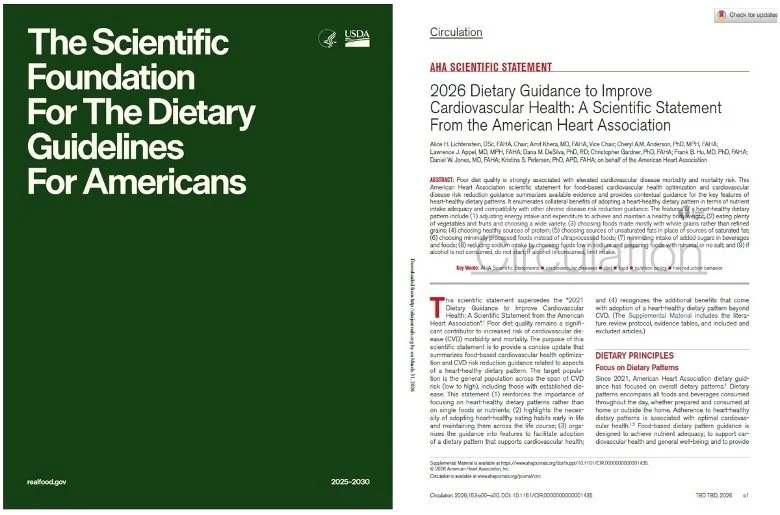
A comprehensive Scientific Foundation review underpins the new DGAs, while a new statement by AHA diverges on several topics and subjects.
AHA Issues 2026 Dietary ‘Guidance’: What It Says, What It Doesn’t, and What It Means
By the Carver Center for Agriculture & Nutrition
The federal government’s recently updated 2025-2030 Dietary Guidelines for Americans are grounded in a comprehensive Scientific Foundation report that reviewed the full body of available evidence on diet and health and then made explicit determinations about what that evidence can support.
A newly released statement by the American Heart Association (AHA), offering its own position on dietary guidance, should be read with that understanding.
Because the AHA position will reach many Americans and may be adopted as guidance by medical practitioners, here are five things to know about the two sets of guidelines, followed by more detailed information.
The AHA did not introduce a new framework or model. It reaffirmed continuity with its own 2021 guidance – including plant-forward protein, low-fat dairy, unsaturated plant oils over animal fats, and caution on “ultra-processed” foods.
The AHA and the federal government are operating from different governing models, not just different food preferences. The Dietary Guidelines move toward a category-based frame emphasizing minimally processed whole foods. The AHA continues within a nutrient substitution framework rather than evaluating whole foods in their full nutritional context. That structural difference can determine downstream policy consequences.
The AHA and the federal Dietary Guidelines agree on more than they disagree. Vegetables and fruits, whole grains, limiting added sugars, limiting sodium, limiting alcohol, and discouraging heavily processed foods are common ground across both documents.
There are three genuine divergences: protein hierarchy, dairy fat, and cooking oils – and they occur in areas where the Scientific Foundation reviewed the evidence and did not support those stronger conclusions. The AHA’s own text acknowledges those scientific limitations while still issuing directional recommendations.
Two of the AHA’s nine writing group members served on the 2025 Dietary Guidelines Advisory Committee whose report the current administration declined to adopt in full. The sequence matters for policymakers: conclusions advanced by that committee were assessed against the full evidentiary record and then not adopted; those same conclusions now reappear in the AHA statement.
What the AHA Updated – and What It Didn’t
The AHA 2026 statement supersedes its 2021 guidance. Comparing the two statement documents directly, the substantive changes are modest.
Strengthened: Alcohol guidance. The 2021 statement retained residual language about a possible protective J-curve effect of low-to-moderate alcohol on coronary heart disease risk. The 2026 statement drops this framing entirely, cites Mendelian randomization evidence finding no causal cardiovascular benefit from alcohol, and aligns with the 2025 AHA/ACC blood pressure guideline recommending avoidance. This is a genuine scientific update and one of the few areas where the 2026 statement is materially more restrictive than its predecessor.
Softened: Fat source language. The 2021 statement prohibited specific foods by name — use liquid plant oils rather than tropical oils, animal fats (e.g., butter and lard), and partially hydrogenated fats. The 2026 statement reframes as a nutrient ratio: “choose sources of unsaturated fat in place of sources of saturated fat.” Butter and beef tallow are named in the body text as examples, but no longer carry a categorical prohibition in the feature headline. This moves the AHA modestly toward the Dietary Guidelines’ food-based framing.
Dropped: Health equity and structural framing. The 2021 statement contained approximately 800 words on structural racism, neighborhood segregation, targeted marketing of unhealthy foods, and food insecurity as primary challenges to heart-healthy dietary patterns. The 2026 statement omits this section entirely, without acknowledgment. This is the most significant structural change in the update. The Dietary Guidelines’ Scientific Foundation specifically criticized the Biden-era advisory committee report for embedding health equity as an “interpretive filter” on scientific conclusions, noting the term appeared more than 170 times in that report. The AHA’s revision excises the same framing.
Unchanged: The core AHA analytical model. Plant-forward protein hierarchy, low-fat dairy, unsaturated plant oils, and caution on “ultra-processed” foods carry forward from 2021 without material modification.
Where the Two Diverge
There are three areas of genuine disagreement between the new DGAs and the new AHA statement. In each case the divergence reflects not new evidence, but different judgments about what the existing evidence can support.
Protein Hierarchy
DGA recommendation: Consume a variety of protein foods from both animal and plant sources. No mandated hierarchy. The Scientific Foundation review evaluated and did not support the previous committee’s recommendation to reorder protein food subgroups to list beans, peas, and lentils first, calling it a “symbolic reordering lacking scientific justification.”
AHA statement: Shift from meat toward plant sources – legumes and nuts first, followed by fish and seafood, then low-fat dairy, then lean unprocessed meat if desired. The statement asserts that “dietary patterns higher in plant sources of protein and lower in animal sources of protein are associated with better cardiovascular health.”
Watch out: The AHA 2026 statement acknowledges that “the relationship between protein quantity and cardiovascular health is uncertain” before issuing its plant-first recommendation. The evidentiary basis for the hierarchy is substitution analyses from prospective cohort studies – not randomized controlled trials with clinical endpoints. The DGA’s Scientific Foundation specifically critiques cohort substitution models as “descriptive, not experimental,” noting they model hypothetical nutrient exchanges that did not actually occur in any individual’s diet. The Scientific Foundation reviewed this evidence and declined to impose a protein hierarchy on that basis.
Dairy Fat
DGA recommendation: Include full-fat dairy with no added sugars as part of a healthy dietary pattern; three servings per day as part of a 2,000-calorie pattern.
AHA statement: Select low-fat or fat-free dairy products instead of full-fat dairy.
Watch out: The AHA 2026 statement concedes in its own body text that “the potential benefits of low-fat and fat-free dairy products compared with full-fat dairy products are not without controversy and continue to be debated.” It cites a systematic review finding that “limited evidence suggests that substituting higher-fat dairy with lower-fat dairy results in similar CVD risk” and states that “conclusions could not be drawn about the relationship between higher-fat dairy and lower-fat dairy on blood lipids, blood pressure, and CVD mortality because of inadequate evidence.” The AHA statement, then, rests on theoretical fat substitution rather than demonstrated differences in clinical endpoints. The Scientific Foundation notes that earlier low-fat guidance coincided with increased consumption of reformulated products higher in added sugars, emulsifiers, and thickeners. Both documents agree the clinical endpoint evidence is inadequate. They reach opposite policy conclusions from that shared uncertainty.
Cooking Oils and Animal Fats
DGA recommendation: Prioritize olive oil as the primary cooking fat; butter and beef tallow are acceptable alternatives within a balanced dietary pattern.
AHA statement: Use nontropical plant oils — soybean, canola, and olive oils — in place of animal fats including butter and beef tallow.
Watch out: The AHA anchors this recommendation in two claims: that replacing saturated fat with polyunsaturated fat reduces LDL cholesterol, which the AHA treats as a causal risk factor for CVD, and that modeling analyses associate this substitution with reduced coronary heart disease risk. Two elements deserve scrutiny. First, LDL is a surrogate endpoint – and the Scientific Foundation specifically cautions that “improvements in surrogate measures do not always correspond to better clinical outcomes,” citing examples of agents that lowered LDL but produced neutral or adverse effects on actual disease events. Second, the AHA statement itself acknowledges only “limited evidence” that substituting butter with plant oils is associated with lower CVD morbidity and mortality – the clinical endpoint evidence is weak by the AHA’s own account. The Scientific Foundation’s Chapter 5 reviewed the full RCT record on saturated fat-to-linoleic-acid substitution and found that none of the individual trials demonstrated the anticipated mortality benefit, and that early favorable meta-analyses reflected publication bias from previously unpublished null trials. The AHA 2026 statement does not engage this critique.
The Evidentiary Structure
Both documents are grounded in scientific literature. They differ in how evidence is evaluated and what threshold is required before recommendations are made.
The Dietary Guidelines’ Scientific Foundation reviews the full body of available literature, applies defined inclusion criteria, evaluates study design and risk of bias, distinguishes between causal evidence from randomized trials and associative evidence from observational cohorts, and makes explicit determinations about where the evidence is sufficient to support population-level guidance and where it is not. Where evidence does not meet that threshold, it declines to extend conclusions. It functions as an adjudication step – determining what the evidence can support before a recommendation issues.
The AHA statement synthesizes accumulated epidemiological and clinical research, emphasizes consistency across observational and mechanistic evidence, and maintains continuity with its own prior guidance. It does not apply a formal threshold for causal inference before issuing directional recommendations.
This is a methodological difference with real consequences. On contested questions – saturated fat, protein hierarchy, dairy fat – the disagreement reflects not new evidence on either side, but different standards for acting on incomplete evidence.
The DGAC Connection
The AHA 2026 statement includes nine writing group members. Two of them – Cheryl Anderson (UC San Diego) and Christopher Gardner (Stanford) – served on the 2025 Dietary Guidelines Advisory Committee, the Biden-era scientific panel whose report the current administration assessed against the full evidentiary record and declined to adopt when issuing the updated Dietary Guidelines.
The overlap is not incidental. It goes to the core contested questions.
Anderson served on DGAC subcommittees that handled dietary patterns, diet quality, weight management and food sources of saturated fat, which is the subject area where the AHA and the Dietary Guidelines most sharply diverge. Gardner held a key role in the DGAC’s protocol on food sources of saturated fat and cardiovascular disease, including leading the review that produced the DGAC’s recommendation to replace saturated fat with plant-based sources – a recommendation the Scientific Foundation did not support after reviewing the full RCT record.
Anderson and Gardner are now co-authors of the AHA 2026 statement, which reaches the same conclusion through a different institutional channel. The sequence is worth stating plainly: an advisory body advanced a set of conclusions; a federal evidentiary review assessed the full record and determined what the evidence can support; certain conclusions were not adopted; those conclusions are now subsequently advanced through a separate institutional channel.
A Structural Issue – Performance vs. Processing
Both documents caution against “highly processed” or “ultra-processed” foods. Neither provides a policy-ready definition of what that means. This is the central downstream risk.
Process-based classification systems, which categorize foods by the extent and nature of industrial processing rather than nutritional content, are over-inclusive, unstable, and weakly aligned with actual health outcomes. They group foods with very different nutritional profiles into the same category. A whole-milk yogurt with one ingredient can be classified alongside a sugar-sweetened snack cake. Fortified cereals, canned fish, and whole-grain breads face classification pressure despite delivering meaningful nutritional value. Affordability and institutional availability – factors that determine whether guidance reaches the people who need it most – are not considerations in a process-based system.
Performance-based classification evaluates foods by what they contribute: protein content, nutrient density, satiety, validated health outcomes, affordability, and cultural and institutional fit. This is the framework that allows policy to improve the food supply rather than simply restrict it.
The AHA’s nutrient substitution model is compatible with performance-based thinking – it evaluates foods by their fat and fiber profiles, not solely by processing level. The Dietary Guidelines’ “real food” framing moves further toward process-based thinking, which creates operational risk when that framing reaches rulemaking. The joint USDA-FDA effort to establish a uniform definition of “ultra-processed” foods is underway and will be more consequential than either guidance document reviewed here.
For school meals, SNAP, WIC, and other federal nutrition programs, the practical stakes are significant. These programs depend on stable, affordable, protein-dense foods with manageable supply chains and long contract cycles. Classification that excludes products on processing grounds rather than nutritional performance risks reducing program effectiveness precisely where it matters most – participation and delivery.
The Bottom Line
The updated Dietary Guidelines reflect a full evidentiary review that assessed the complete record and set explicit thresholds for what the science can support. The AHA 2026 statement reaffirms its own existing analytical model. It does not introduce new evidence or a new framework.
Where the two diverge, the AHA’s own text acknowledges the evidentiary limitations underlying those divergences.
The more consequential question is structural: whether food and nutrition policy moves toward performance-based standards that allow the food supply to improve, or toward process-based classification that restricts it by category. Both documents gesture toward that distinction without resolving it.
The resolution will come through definitions, rulemaking, and program implementation. That is where the policy consequences will actually be decided, and where the analytical work is most needed.
Sources
AHA Circulation 2026; AHA Circulation 2021; Dietary Guidelines for Americans, 2025-2030; HHS/USDA Scientific Foundation 2025-2030; DGAC Meeting Records 2023-2024; Carver Center comments on Docket No. FDA-2025-N-1793.