Insight: Gallup Data Shows Public Trust is Concentrated in a Few Economic Sectors
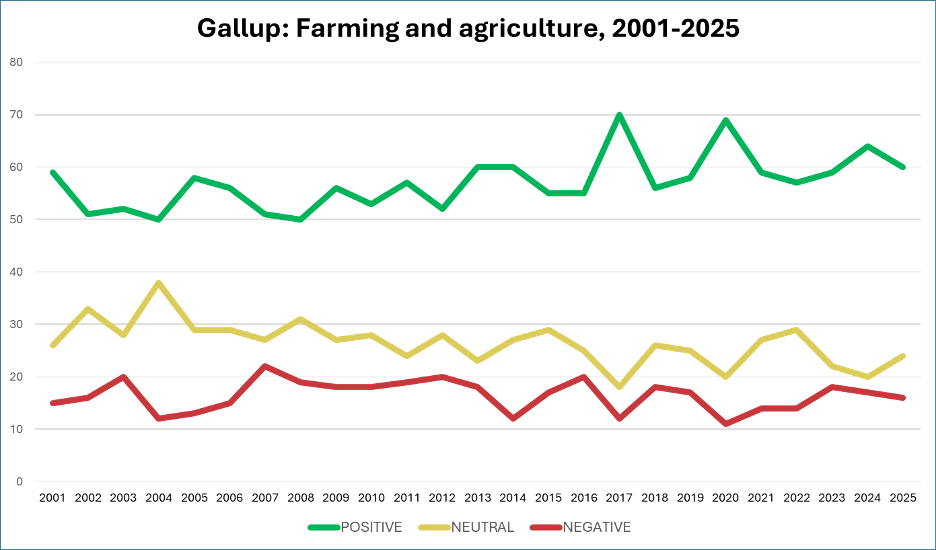
The Leader. Farming and agriculture shows the most strength and support of all economic sectors surveyed by Gallup in the past 25 years.
Insight: Gallup Data Shows Public Trust is Concentrated in a Few Economic Sectors
What 25 years of Gallup polling reveal about food, agriculture, and the baseline policymakers often miss.
By the Carver Center for Agriculture & Nutrition
Public trust is not evenly distributed across the American economy. It is concentrated in a small number of sectors.
That is the central takeaway from a new Carver Center analysis of 25 years of Gallup polling on public confidence in major U.S. industry sectors. Across recessions, political cycles, cultural shifts, and periods of price volatility, Americans have consistently placed their highest and most durable trust in a small set of industries that meet daily needs.
At the top of that list is farming and agriculture.
For policymakers, this matters more than is often acknowledged. Much of today’s food and agriculture debate is framed as though the sector operates from a deficit of public confidence. Advocacy campaigns, media narratives, and even some regulatory approaches assume a baseline of skepticism or distrust. The long-run polling record does not support that assumption.
Gallup’s data show that farming and agriculture is not only highly trusted, but unusually stable. Unlike many sectors whose public standing rises and falls with headlines or crises, agriculture maintains a strong floor of support and one of the highest levels of “very positive” sentiment across the entire 25-year period. Restaurants, grocery retail, and related food sectors also occupy this zone of deep, durable confidence.
Policymakers should start from an accurate baseline and understanding. Highly trusted sectors are not blank slates. Policymakers who seek or take actions with negative impacts in these sectors carry different risks than similar actions elsewhere in the economy.
One outcome of the Carver analysis is that it shows how closely public sentiment tracks economic conditions, particularly prices and affordability. Sectors most sensitive to interest rate fluctuations show corresponding up-and-down fluctuations in trust and sentiment. Consumer-facing sectors exhibit shifts in sentiment that mirror shifts in prices and costs.
The Carver Center’s analysis also highlights a broader pattern. Public trust is not a universal condition to be repaired across all industries. Sectors that delivered during the Covid-19 pandemic saw corresponding spikes in positive sentiment. Sectors with negative issues that have penetrated society show up - such as concerns about accounting practices in the early 2000s.
Public trust, the data show, is a scarce asset, concentrated in sectors that deliver visible, everyday value. Treating sentiment – positive and negative – as evenly distributed leads to miscalibration. Treating it as earned and durable leads to better policy design.
That is why long-run sentiment matters. Annual polls capture noise. Headlines capture moments. Durable trust reflects real-world experience over time.
The full Carver Trust Index examines all 25 Gallup-tracked industries across five dimensions, including median support, stability, and long-run trends. The findings provide a clearer picture of where public confidence actually resides and where policymakers should tread carefully.
Sound policy begins with an accurate understanding of public reality. Baseline trust is part of that reality.