
Kellie Adesina on Food Affordability, Nutrition and the Future of Agricultural Research
Kellie Adesina on Food Affordability, Nutrition and the Future of Agricultural Research
A Carver Center series featuring leaders, researchers, policymakers, and innovators shaping the future of food and agriculture.
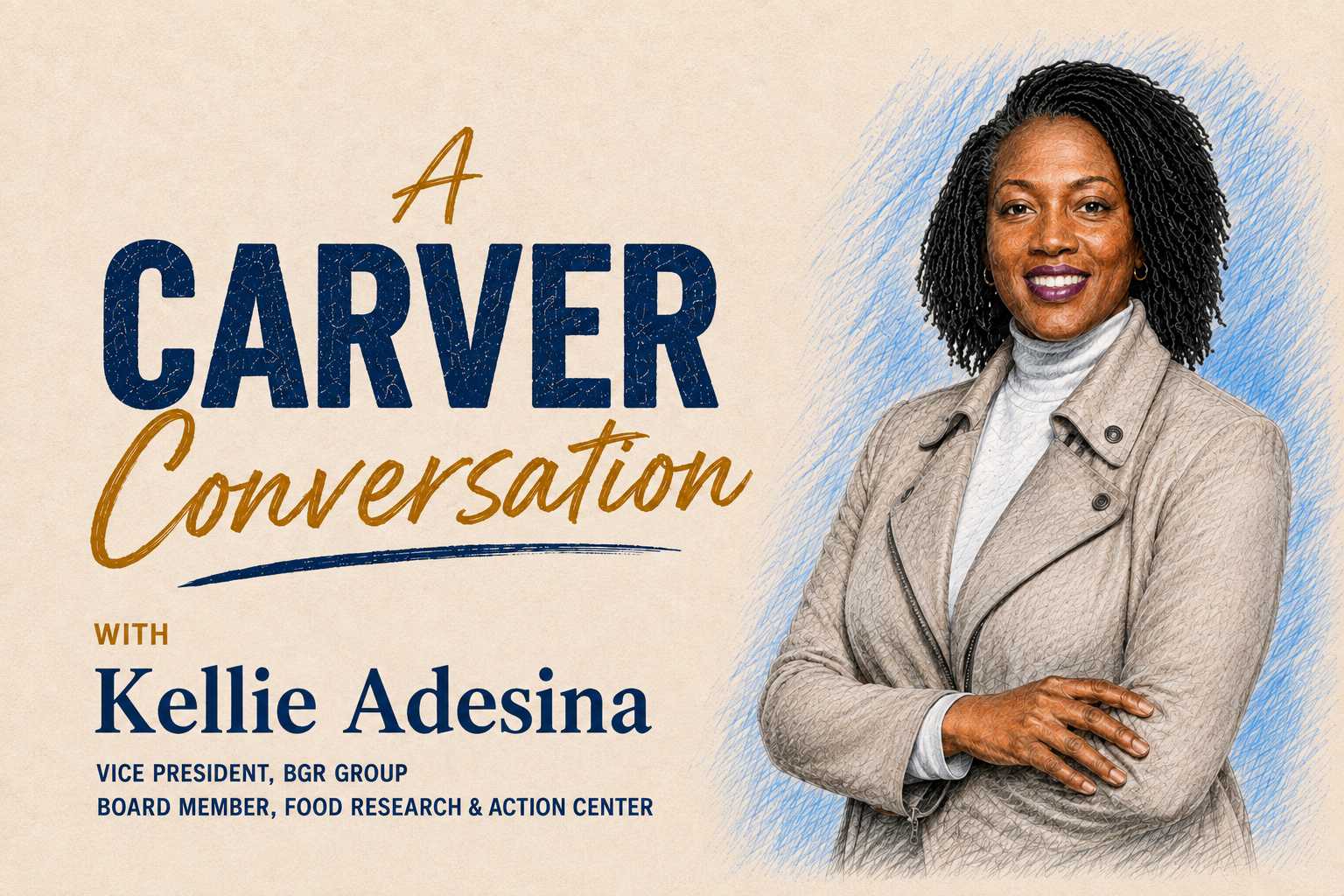
Kellie Adesina has spent her career working on food and agriculture issues from nearly every angle. Her experience spans Congress, the U.S. Department of Agriculture, and the private sector, where she has helped shape policy, advise decision makers, and navigate some of the most complex challenges facing our nation’s food system. As Chief Counsel for the House Agriculture Committee, she helped shape the 2018 Farm Bill and advised lawmakers on issues including nutrition and agricultural research.
Kellie recently joined BGR Group, a government relations and strategic consulting firm, where she advises clients on food and agriculture policy, legislative strategy, advocacy, and coalition building. Drawing on her experience in the public and private sectors, Kellie helps organizations navigate the policy landscape and engage effectively with decision makers. She also serves on the Board of Directors of the Food Research & Action Center.
1. The Carver Center's focus is on how to provide food affordably, at scale, for everyone who needs it. Thinking about agriculture, food, and nutrition in the United States, what does affordability mean to you in practice?
Affordability is fundamentally about access. We sometimes take for granted that getting to a grocery store is as simple as a short drive. For millions of Americans living in food deserts, it isn't. Distance alone can make food inaccessible before price even enters the equation.
Also, price doesn’t mean the same thing for everyone. What's affordable for one family may be out of reach for another. To put that in concrete terms, according to FRAC's FY2026 Budget and Appropriations Priorities, the average SNAP benefit is about $6.20 per person per day. Even though most SNAP recipients supplement those benefits with their own money, their total food budgets are still a fraction of what households spending primarily on organic or fresh produce may typically spend. That gap matters.
This is why the ability to produce food at scale is so important. Scale keeps prices low. It ensures that staple foods, including shelf-stable products that stretch budgets and reach communities with limited fresh food access, are available and attainable for as many Americans as possible. Affordability isn't just about what something costs on a shelf. It's about whether people can actually get to that shelf, and whether what's on it fits within their means.
2. Looking back, where did reality differ most from what you expected?
Honestly, I never expected to find myself in this field. I grew up with the assumption that agriculture was a world you had to be born into, that you needed to have grown up on a farm, been part of 4-H or FFA, or come from rural America to have any real credibility here. That assumption turned out to be wrong and recognizing that was one of the more meaningful surprises of my career. Growing up in Newark, New Jersey — and spending summers in Los Angeles, California — I was about as far from a rural upbringing as you can get. However, what I learned is that agriculture is ultimately about something universal: making sure people have access to safe, affordable, and nutritious food. That's a value that transcends geography and background, and it opened a door I didn't initially think was mine to walk through.
What I've also discovered is that my urban perspective isn't a liability in this space; it's an asset. I can help non-farm audiences understand why practices that might sound counterintuitive actually matter. Why, for example, using herbicides helps farmers achieve climate goals by reducing the need to plow fields, which in turn reduces soil carbon release and improves soil health. Or why crop insurance isn't just a subsidy debate, but a genuine risk management tool for farmers whose livelihoods are at the mercy of weather and other variables beyond their control.
It works in the other direction, too. I can bring the realities of urban food access, food deserts, budget constraints, the distance some families must travel just to reach a grocery store, into conversations with farm country in a way that feels authentic, because it is. That two-way translation, I've found, is where I add the most value.
3. What do people outside food and agriculture misunderstand most often?
Did you know that yogurt and whole grain bread are both classified as “ultra-processed foods”? Most people's reaction to that is genuine surprise, and that reaction is actually the point. The conversation around ultra-processed foods is one we should welcome, because what we eat and how our food is made should be scrutinized. However, I think we're asking an incomplete question. Most of the “UPF” discussion is anchored in the NOVA classification system, which categorizes foods based on how they were processed rather than their nutritional value. When that framework puts yogurt in the same category as foods that offer little nutritional benefit, it's worth asking whether we're measuring the right things.
Processing isn't inherently bad. Foods are often processed to ensure they're shelf-stable and fortified, and many deliver real nutritional value. The more useful question isn't was this food processed? It's what does this food do for your body? We've gotten good at labeling, but labeling isn't the same as understanding. The question I'd love more people to sit with is: if the goal is genuinely better nutrition outcomes, shouldn't nutrient density be a better place to start than the method by which something was made?
4. What conversation should we be having right now that we're not?
The United States is steadily falling behind China, Brazil, and India on public agricultural research and development—and not nearly enough people are sounding the alarm. Private dollars have helped fill some of the gaps, but they haven't filled all of it. Private dollars also can't replace the kind of foundational, public-interest research that only government investment sustains. According to different reports, China surpassed the U.S. as the world's largest public funder of agricultural R&D a decade ago, and its investments have since nearly doubled ours. India and Brazil are closing fast. This isn't just a budget line item: it's a competitiveness and national security issue.
Robust agricultural research is what keeps productivity growing, food systems resilient, and farmers equipped to respond to new threats before those threats become crises. Fall behind on research today, and we're accepting supply shocks, lost export markets, and farmer vulnerability tomorrow. The U.S. built its agricultural dominance on innovation. The question we should be asking now is whether we're doing enough to protect it.
5. What drew you to this next step at BGR?
I wanted the opportunity to engage with the full breadth and depth of food and agriculture issues. I wanted a role where I could engage the entire food supply chain, tackle a wider variety of challenges, and have conversations that shift meaningfully from day to day. I also wanted to be more involved in strategy development: thinking through how to respond to complex, multifaceted issues rather than operating within a narrower lane.
As for why the BGR Group specifically, it came down to reputation and opportunity. BGR is a well-respected firm known for delivering excellent client service, and that standard mattered to me. Equally compelling was the chance to help grow a burgeoning food and agriculture practice. The entrepreneurial dimension of that—building something, not just joining something—really resonated with me. I’m excited for the opportunity to work with an array of clients on a wide range of issues in this critical field.