
In 7-2 Decision, the Supreme Court Rules Federal Law Governs Pesticide Warnings
In 7-2 Decision, the Supreme Court Rules Federal Law Governs Pesticide Warnings
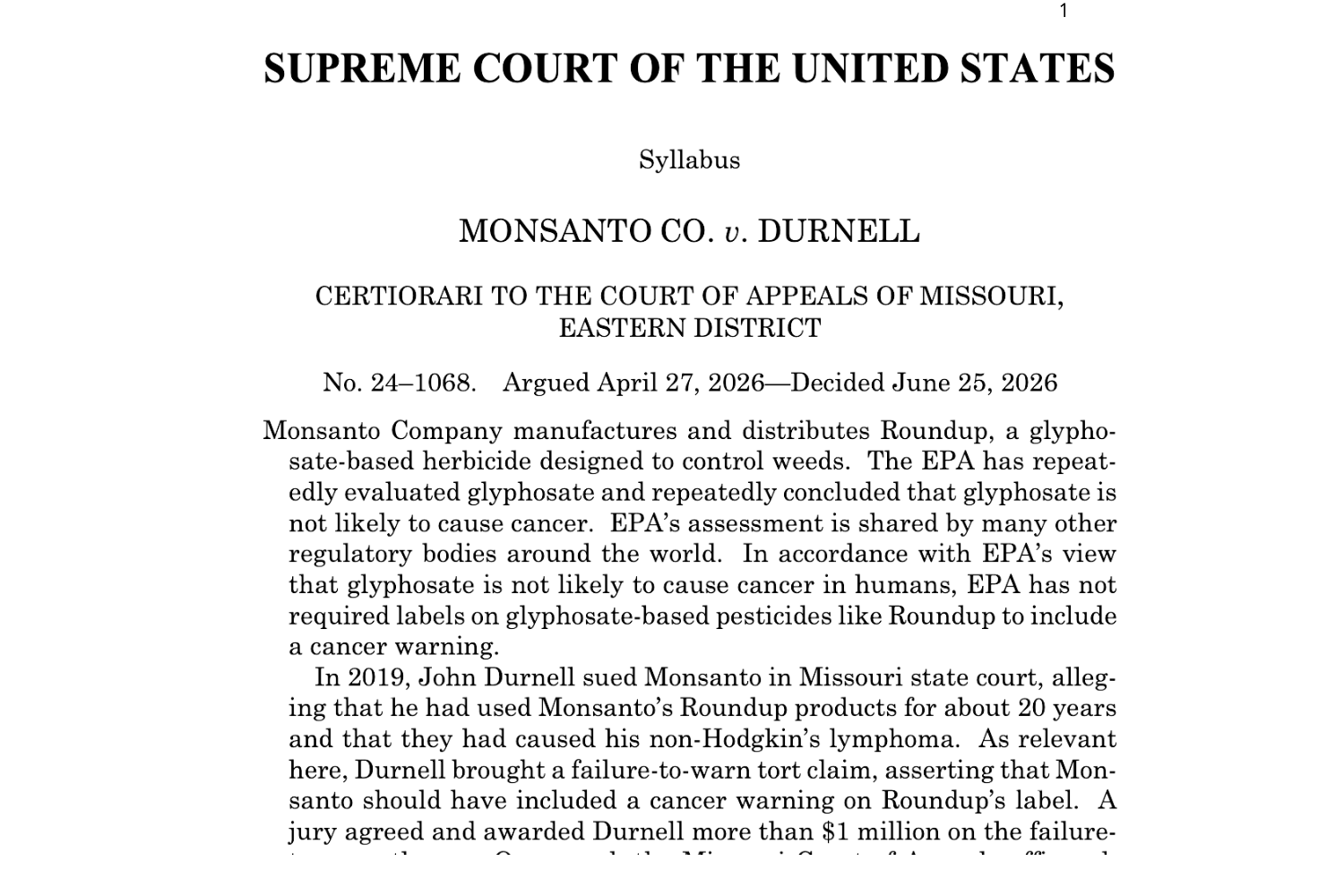
The Supreme Court today resolved one of the most consequential agricultural cases in recent years, holding that the Federal Insecticide, Fungicide, and Rodenticide Act expressly preempts a state-law failure-to-warn claim seeking to require a cancer warning on Roundup’s label.
In a 7–2 opinion authored by Justice Brett Kavanaugh, the Court held that FIFRA’s registration process requires EPA to determine whether a pesticide label contains all warnings necessary to protect health and the environment. Once EPA approves that label, federal law requires manufacturers to use it unless and until EPA approves or requires a change. Because Missouri’s failure-to-warn claim would have required Monsanto to add a cancer warning that EPA has repeatedly declined to require, the Court concluded the claim imposed a labeling requirement “in addition to or different from” those required under FIFRA — and is therefore expressly preempted.
Chief Justice Roberts and Justices Thomas, Alito, Sotomayor, Kagan, and Barrett joined the majority. Justice Jackson dissented, joined by Justice Gorsuch.
Justice Thomas filed a separate concurrence agreeing with the majority's statutory conclusion but expressing doubt about whether Congress may constitutionally authorize agency regulatory decisions to define the scope of state-law preemption. Those constitutional questions — touching on the Commerce Clause, delegation, and the Supremacy Clause — were not before the Court and do not alter the majority's holding. His concurrence is best read as a reservation for future cases, not a qualification of today's result. Justice Gorsuch, by contrast, never reached those constitutional questions because he disagreed with the majority at the threshold: in his reading, EPA registration does not create a binding federal requirement in the first place, which is why he joined the dissent rather than the majority.
With this decision, the Court provides greater legal certainty for American agriculture by holding that Congress's nationally uniform pesticide labeling system, not differing state tort requirements, governs federally approved pesticide warnings.
The Carver Center published a preview guide and a justice-by-justice oral argument analysis following the April 27 argument. This post anchors in the decision itself — what the Court held, why, and what it did and did not decide.
KEY TAKEAWAYS
EPA-approved pesticide labels carry legal force under FIFRA. States may not use tort law to require additional or different warnings where EPA has determined they are not required.
The decision reinforces Congress’s choice of a nationally uniform labeling system. Disputes over pesticide warnings belong within the federal regulatory framework Congress established — not in state tort courts.
The ruling does not definitively end pesticide litigation. It resolves a specific failure-to-warn theory. Other claims and future regulatory proceedings remain possible.
Why the Decision Matters
The immediate consequence of the Court’s decision extends beyond Roundup.
By holding that FIFRA’s registration process and EPA-approved labeling preempt conflicting state-law failure-to-warn claims, the Court reaffirmed Congress’s decision to create a nationally uniform system for pesticide labeling. Manufacturers remain responsible for reporting new information to EPA, and EPA retains authority to require new warnings, amend labels, suspend registrations, or cancel products as scientific evidence evolves. But under today’s decision, those changes are to occur through the federal regulatory process Congress established — not through individual state tort verdicts imposing different labeling requirements.
The practical significance of today’s decision is that the principal debate over pesticide warnings returns to EPA, where Congress placed it.
The decision does not definitively eliminate pesticide litigation. The Court addressed only the failure-to-warn claim before it and expressly resolved the case on FIFRA’s preemption provision. Other legal theories and other factual circumstances may continue to be litigated.
What today’s opinion does change is the principal forum for disputes over federally approved pesticide warnings. Where Congress has established a comprehensive federal labeling process, the Court held that state-law claims cannot be used to require warnings different from those approved by EPA.
What the Case Was About
John Durnell sued Monsanto in Missouri state court in 2019, alleging that two decades of Roundup use had caused his non-Hodgkin’s lymphoma. A jury agreed on a failure-to-warn theory and awarded him more than $1 million. Monsanto moved for judgment notwithstanding the verdict on preemption grounds; the Missouri trial court and the Missouri Court of Appeals both rejected that argument. The Supreme Court granted certiorari to resolve a split among federal and state courts on whether FIFRA preempts failure-to-warn claims based on Roundup’s lack of a cancer warning.
As the Carver Center noted in its statement the day of argument, the case was never about whether glyphosate causes cancer: “The Court is not being asked to decide whether glyphosate causes cancer. It is being asked who has authority to decide what goes on a federally regulated label.” Today’s opinion largely proceeds on that same distinction. The Court does not resolve the underlying science. It resolves a structural question about which regulatory system governs what appears on a federally regulated label.
What the Court Held
FIFRA’s preemption clause — titled “Uniformity” — provides that a state “shall not impose or continue in effect any requirements for labeling or packaging in addition to or different from those required under” FIFRA. The majority held that EPA’s registration determinations, including its repeated approval of Roundup’s label without a cancer warning, constitute federal requirements “under” FIFRA. A state-law claim that would require a different or additional warning is therefore expressly preempted.
The majority grounded this in FIFRA’s registration structure. To register a pesticide, EPA must evaluate the proposed label and determine that it contains all warnings “necessary and adequate to protect health and the environment” and that it is not false or misleading. After registration, the manufacturer is legally required to use the EPA-approved label. It may not change the label without EPA approval, and doing so without approval exposes the manufacturer to civil and criminal penalties. EPA has evaluated glyphosate’s carcinogenic potential multiple times — in 1991, 1993, 2017, 2019, and 2020 — and has concluded each time that glyphosate is not likely to cause cancer in humans. That assessment is shared by regulatory bodies in Canada, Australia, Japan, and the European Union. Federal law accordingly does not require a cancer warning on Roundup’s label. Missouri’s failure-to-warn claim, which would mandate one, imposes a requirement “in addition to” what federal law requires.
The majority drew on Riegel v. Medtronic (2008), which held that FDA’s premarket approval of a medical device imposes requirements under the Medical Device Amendments that preempt additional state-law requirements. FIFRA’s preemption clause and the Medical Device Amendments’ preemption clause are nearly identical in text; the majority held the same logic applies. The majority also addressed Bates v. Dow Agrosciences (2005), which had anchored lower court decisions rejecting preemption. The majority distinguished Bates on the ground that the claims there involved efficacy — which EPA does not review at registration — rather than safety, which EPA does thoroughly review. Safety-based failure-to-warn claims that conflict with EPA’s registration determinations are preempted; Bates does not foreclose that conclusion.
Because the Court resolved the case on express preemption grounds, it did not reach Monsanto’s implied preemption argument.
What the Court Did Not Hold
The majority was precise about what the decision does and does not do.
The Court's holding is jurisdictional, not scientific. What warnings appear on a federally registered pesticide label is governed by FIFRA and EPA's registration process. The science of glyphosate remains where it was before today's decision — in the regulatory process Congress created to evaluate it. EPA’s repeated conclusions about glyphosate are the basis for the current label; those conclusions can change. FIFRA provides mechanisms for that: manufacturers must report new information about unreasonable adverse effects; EPA may require amended labeling or pursue cancellation proceedings; and any person may petition EPA to modify, suspend, or cancel a registration, with judicial review available if EPA declines.
Because the claim before the Court was a label-based failure-to-warn claim, the opinion does not decide the treatment of other product-liability theories.
Justice Thomas's concurrence flags constitutional questions about agency-created preemption for future cases. Today's holding rests entirely on statutory grounds.
The Dissent
Justice Jackson, joined by Justice Gorsuch, dissented on the ground that EPA’s registration and label approval do not create a “requirement” under FIFRA for purposes of the preemption clause.
In the dissent’s reading, FIFRA’s misbranding prohibition — not the EPA-approved label — is the operative federal requirement, and it remains in force even after registration. The dissent relied heavily on § 136a(f)(2), which provides that registration “shall not be construed as a defense for the commission of any offense” under FIFRA. That provision, the dissent argued, establishes that EPA’s registration is only prima facie evidence of compliance — not conclusive evidence — meaning the approved label cannot itself constitute a binding federal requirement. A state tort claim that parallels FIFRA’s misbranding prohibition does not add to or differ from federal requirements; it enforces them.
The dissent argued that Bates, not Riegel, is the controlling precedent, and that Bates’ remand for parallel-claim analysis necessarily rejected the theory the majority adopted today. The dissent also contested the impossibility framing, arguing that federal law did not categorically foreclose label changes and that Monsanto had regulatory avenues — including amended registration and, in the dissent’s view, the notification pathway — to seek or make a warning change.
The majority responded to each of these arguments at length. On § 136a(f)(2), the majority held that the provision, by its text, applies only to EPA enforcement actions — not state tort suits — and that reading it to negate the preemption clause would effectively erase that clause from the statute. On Bates, the majority held the safety/efficacy distinction is the operative one. On the label-change pathways, the majority — relying on the government’s express representation at oral argument — concluded that cancer warnings are precautionary statements requiring EPA approval before any change.
What Our Preview and Analysis Identified
For those following the Carver Center’s work on this case, several observations.
Our oral argument guide — distributed before the April 27 argument and available on our website — identified the Bates/Riegel divide, the § 136a(f)(2) registration-not-a-defense clause, the feasibility of unilateral label changes, and the role of judicial interpretation under Loper Bright as the four key turning points. The majority resolved the case on express preemption grounds. Readers familiar with the Guide will recognize the central role the Court ultimately gave to the Bates/Riegel distinction. Loper Bright played a minimal role in the majority’s analysis, consistent with what we observed at argument — Justice Alito’s direct challenge to the respondent’s extension of that doctrine to the preemption context appeared to foreclose the argument, and the majority did not rely on it.
Our post-argument analysis identified Justice Kavanaugh’s retroactivity framing as an unanticipated development that “may be the organizing principle of a majority opinion if Monsanto prevails.” The majority opinion, written by Justice Kavanaugh, incorporates that concern directly, observing that the law ordinarily is not read to retroactively penalize parties for doing what the government required.
Our analysis also anticipated that the interregnum problem — what happens when new information emerges before EPA acts — would be the fault line most likely to produce a limiting principle or significant concurrence. The majority addresses it by pointing to FIFRA’s existing regulatory mechanisms rather than carving out a doctrinal exception. The dissent presses that point at length. Although it did not alter the outcome, it remains a practical tension within FIFRA’s regulatory framework.
What Comes Next
The Court’s decision resolves the preemption question that has divided federal and state courts for years. It does not resolve the broader landscape of pesticide litigation or the ongoing scientific and regulatory debate over glyphosate.
For pending failure-to-warn claims based on Roundup's EPA-approved label, today’s decision is controlling. Those claims are preempted under FIFRA where EPA has not required the warning at issue.
For the regulatory process, the decision returns primary authority to EPA. Parties who believe glyphosate’s label is inadequate have the avenues FIFRA provides: petitioning EPA to modify, suspend, or cancel the registration, with judicial review available if EPA declines. Manufacturers, meanwhile, remain obligated to report new information about adverse effects to the agency.
The decision’s reach beyond pesticides may also be significant. The majority drew an explicit parallel between FIFRA’s preemption clause and similarly worded clauses in other federal statutes governing food, drugs, medical devices, and consumer products. How lower courts apply today’s reasoning to those adjacent contexts will be worth watching.
The Carver Center for Agriculture & Nutrition is a nonprofit research organization focused on affordability, access, and evidence-based food and agriculture policy. Reach us at info@carverfood.org or visit carverfood.org.