
Patchwork Regulation Is a Land of Oz
Patchwork Regulation Is a Land of Oz
By the Carver Center for Agriculture & Nutrition
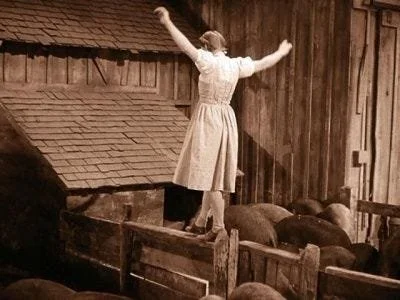
There is a brief scene early in The Wizard of Oz that modern audiences barely notice. Dorothy is at the pig pen on her family’s Kansas farm. She hops onto the fence rail, arms wide for balance, and inches forward. Suddenly, she slips and falls in. Zeke, the farmhand, rushes over and pulls her out. He then wobbles over to a stool, clutching his chest, visibly shaken.
When the film premiered in 1939, no explanation was needed.
Everyone understood the danger. Pigs are not cartoons. A sow protecting her litter can maim or kill. Falling into a pig pen was a serious threat. That shared understanding is why Zeke, who later appears as the Cowardly Lion, made sense to audiences at the time. Fear of pigs was known, and real.
That context matters, because it has largely disappeared.
Today, many Americans encounter farming only through children’s books and animated characters. Pigs are polite. Farms are pastoral. Risk is abstract. In the absence of real-life experience, symbolism fills the gap.
Increasingly, policy is being written to satisfy the symbolism rather than the reality.
That is the backdrop for a broad patchwork problem now confronting American agriculture, particularly in labeling, permitting, and in a California rule known as Proposition 12 that is a significant part of current discussion.
Proposition 12 does not regulate how pork is produced in California alone. It conditions access to California’s market on compliance with California’s housing standards and enforcement regime, regardless of where the animals are raised. A farm in Iowa or Indiana, in Michigan or Missouri, must either redesign its operation to meet California’s preferences or lose access to one of the nation’s largest markets.
The rule is expansive, and its application is arbitrary.
The same pig, raised on the same farm, under the same veterinary oversight, may produce meat that is legal or illegal in California depending solely on how it is later processed or prepared, decisions made far from the farm. A farmer who ignores the California farm-housing rule may still see her meat sold as cooked bacon, ground pork, sausage, and other products in California. But as a fresh pork chop, it becomes illegal, with criminal penalties as enforcement. The animal does not change. The farm conditions do not change. The law does. That inconsistency is not a function of science or safety. It is a function of jurisdictional overreach.
Supporters of Proposition 12 often frame the issue as a simple matter of compassion. But modern animal care is governed by veterinary science, animal behavior, disease management, and risk mitigation. Housing systems exist because animals can injure one another, compete for food, or experience stress in ways that outsiders rarely see. Farmers and veterinarians work together to manage those risks. Removing flexibility through one-size-fits-all mandates does not guarantee better outcomes. In some cases, it undermines them.
The deeper problem, however, is not any single standard. It is a precedent.
If one state may dictate production standards for all others as a condition of market access, there is no limiting principle. Today it is animal housing. Tomorrow it may be feed composition, genetics, water use, carbon scoring, or labor practices. Once authority migrates from the producing state to the purchasing state, the national market becomes a negotiation among fifty regulators rather than a system governed by shared rules.
This is the patchwork problem.
Congress has the power and the requirement to prevent it. A broad range of farmers, agricultural organizations, grocers, and restaurateurs are working toward a policy solution that addresses this issue, seeking to reaffirm that production standards belong to the producing state, while sales that take place within a state remain subject to that state’s laws.
This balance matters. It preserves federalism without allowing one state’s preferences to become everyone else’s obligations.
The Constitution anticipated this problem. Interstate commerce was placed under federal authority precisely to prevent states from governing one another. The Supreme Court, across multiple opinions, and administrations under both President Trump and President Biden have acknowledged the serious burdens imposed by extraterritorial regulation. The remedy, however, belongs to Congress.
This conflict is not unique to agriculture. It is part of a broader struggle over who governs national markets in an interconnected economy. States are now attempting to set their own rules for artificial intelligence, even though AI systems operate across borders by design. The European Union has imposed deforestation requirements that reach deep into global supply chains, prompting objections from U.S. producers and Native American tribes whose land-use practices were never contemplated by European policymakers. By contrast, when California regulates vehicle emissions, it does so under explicit authority granted by Congress through the Clean Air Act. That distinction matters. Federal delegation is not the same as unilateral extraterritorial regulation.
Agriculture has never been delegated to any one state to govern on behalf of all others. When Congress remains silent, the result is not federalism, but fragmentation.
This is the larger lesson behind the Oz metaphor. When Dorothy fell into the pig pen, the audience understood the risk immediately. Today, distance from farming has replaced shared knowledge with abstraction. Policy built on illusion rather than reality may feel virtuous, but it carries real consequences for food affordability, market stability, and constitutional order.
The Carver Center for Agriculture & Nutrition is examining this patchwork problem across sectors, because food will not be the last national system tested by fragmented authority. We invite feedback, critique, and engagement as we develop forthcoming analysis on the Patchwork Problem and the future of state and federal governance in a modern economy.
Sound policy begins with clarity about where authority belongs, and honesty about the costs when it is misplaced.
The Carver Center for Agriculture & Nutrition is examining this patchwork problem across the food system. We invite feedback, critique, and engagement as we develop forthcoming reports.