
Our Mount Rushmore: Risk-based Science Feeds and Protects
Our Mount Rushmore: Risk-based Science Feeds and Protects
Why food and farming depend on practical decisions, not hazard absolutism
By the Carver Center for Agriculture & Nutrition
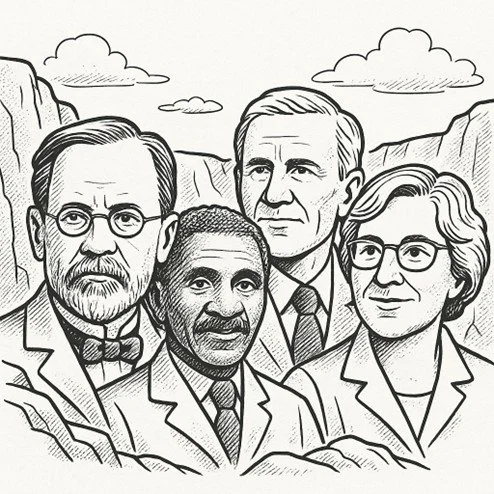
At the Carver Center, we focus less on abstract debates about “trusting science” and more on a practical question: how should science be used to make food safer, farming more resilient, and diets more affordable in the real world? The answer depends on how science is translated into decisions that operate at scale, under uncertainty, and in living systems.
Across food and farm policy circles, an old regulatory divide has resurfaced with renewed intensity. It is often described in technical terms, but its implications are concrete. The divide in regulatory decision-making is between risk-based and hazard-oriented approaches to science, and it increasingly shapes decisions about crop protection, food ingredients, biotechnology, animal health tools, and the pace of agricultural innovation.
A clear explanation of this distinction helps illuminate what is at stake:
Risk-based science asks a forward-looking question: what is the likelihood of harm at real-world levels of exposure and use? It is explicitly designed for decision-making, not for theoretical completeness. It combines information about intrinsic properties with data on how, how much, and how often something is actually encountered. Uncertainty is addressed through conservative assumptions, safety factors, margins of exposure, and ongoing monitoring. This approach exists precisely because decisions must be made before uncertainty disappears. People need safe, affordable food now, not at some hypothetical point of perfect knowledge.
Hazard-oriented approaches begin from a different premise. They focus first on whether a substance or technology can cause harm under any plausible condition, sometimes independent of realistic exposure. In certain regulatory settings, the identification of a hazard can trigger restriction even when exposure is limited or controllable. The result is a system that tends to resolve uncertainty by exclusion rather than by managed use.
The United States has historically regulated food and agriculture primarily through a risk lens. The European Union places greater weight on hazard classification in specific policy domains, particularly where legislation establishes intrinsic-property “cut-off” criteria. This distinction is often blurred in public debate, so precision matters. Europe does not ignore exposure or risk. European authorities conduct formal risk assessments, including exposure analysis, through institutions such as EFSA. The distinction is on how much weight scientific judgment retains once a hazard is identified in law.
This balance point matters enormously in food and farming. Agriculture operates in open systems subject to weather, pests, disease pressure, and shifting market conditions. Fields and barns are not controlled laboratories. Neither are supply chains, kitchens, or communities. Food systems succeed or fail based on how science performs once it leaves the lab and enters daily life.
A regulatory philosophy that requires laboratory-style certainty across all contexts before allowing use does not merely slow innovation. It systematically narrows the set of tools available to farmers and producers, with predictable consequences for productivity, cost, and resilience.
What Europe actually does, and why nuance matters
Public debate often reduces transatlantic differences to slogans. “Europe bans what America allows” is a common refrain. Sometimes it is true. Often it is incomplete or misleading.
First, Europe’s regulatory framework combines hazard identification with risk assessment and risk management rather than relying on hazard alone. Under systems such as REACH, manufacturers must provide information on hazards, uses, and exposure to demonstrate safe use. The presence of hazard does not automatically translate into prohibition across all contexts.
Second, in certain areas, especially some pesticide approvals and endocrine-disruptor classifications, European law includes hazard-based cut-off provisions. These provisions can limit or foreclose approval based on intrinsic properties, even when exposure-based risk arguments are strong. This is the core of the hazard-versus-risk tension in EU agricultural policy, and it is where practical consequences are most visible.
Third, claims about what is “banned in Europe” frequently collapse under scrutiny. Substances that are widely believed to be prohibited may be permitted under different authorizations, different concentration limits, different use conditions, or different regulatory categories. Food additives illustrate this clearly. Europe’s E-number system and category-specific permissions do not map neatly onto U.S. labels, and public comparisons often confuse use restrictions with outright bans. Accurate comparison requires reading regulatory texts, not circulating lists.
Fourth, Europe is deeply embedded in global food trade. It imports substantial volumes of food and agricultural products, including from systems that operate under different regulatory assumptions. Whatever one’s view of European domestic policy, this reality complicates claims that a hazard-forward posture produces a uniquely pure or chemical-free food system in practice.
For the Carver Center, the point is not to litigate every regulatory difference. It is to highlight a broader truth. Hazard-based narratives are rhetorically powerful because they sound absolute. Risk-based science is operationally effective because it confronts complexity instead of denying it. Public protection depends on effectiveness, not rhetoric.
A Mount Rushmore of pragmatic food science
With that framework in mind, consider a different question than the one that dominates policy debates.
What if we built a Mount Rushmore not of slogans about science, but of scientists whose work fed millions, reduced harm, and improved public health under real-world conditions?
Four figures stand out, not because they avoided uncertainty, but because they worked responsibly within it.
Louis Pasteur: Managing risk at scale
Pasteur transformed food safety by demonstrating how microbial risk could be dramatically reduced through practical intervention. Pasteurization does not eliminate microbes as a hazard category. It lowers exposure to dangerous pathogens in a way that can be applied broadly and reliably. This is the essence of risk management: acknowledging hazards exist, then reducing the likelihood of harm in the world as it actually functions.
George Washington Carver: Science as service under constraint
Carver’s work at Tuskegee was not built on controlled perfection. It was applied science directed at soil restoration, crop diversification, nutrition, and farm resilience under severe constraints. His legacy underscores that scientific legitimacy is earned through tangible improvements in people’s lives, not through theoretical purity.
Norman Borlaug: Abundance through adaptation
Borlaug’s Green Revolution achievements emerged from constant adaptation in fields facing disease, climate stress, and political urgency. His work could never have satisfied demands for perfect reproducibility before deployment. The alternative to action was famine. His career illustrates that in food systems, the cost of delay is often measured in human suffering.
Mary-Dell Chilton: Innovation through managed uncertainty
Chilton’s foundational contributions to plant biotechnology opened a new chapter in agricultural science. Early applications were incremental and controversial. Progress depended on regulatory frameworks that evaluated risk case by case, established guardrails, and allowed learning through use rather than prohibition by conjecture. Crucially, these systems required continuous feedback from those deploying the technology, not insulation from them. Modern biotechnology’s benefits are the product of that disciplined pragmatism.
These four figures share a common orientation. None waited for flawless evidence. None treated uncertainty as a reason to stand still. Each advanced public welfare by managing risk rather than by attempting to eliminate hazard in the abstract.
Other giants considered
Many others merit serious recognition. Clarence Birdseye expanded food preservation and affordability. Harvey Wiley helped catalyze modern food law. Joseph Goldberger transformed understanding of nutritional deficiency. Ellen Swallow Richards linked chemistry, sanitation, and nutrition to public health. Gertrude Mary Cox provided agriculture with statistical tools suited to complex, variable field conditions.
But Mount Rushmore is about symbolism as much as accomplishment. Pasteur, Carver, Borlaug, and Chilton represent four enduring pillars of the modern food system: safety, stewardship, abundance, and innovation.
The Carver Center’s position
Risk-based science is a structured way to protect public health while still enabling progress. It uses conservative exposure assumptions, safety factors, and ongoing oversight because regulators recognize that uncertainty is unavoidable in complex systems. It is also explicit about tradeoffs, which makes it more honest, not less protective.
Crucially, risk-based systems leave room for real-world involvement by those who develop, use, and improve technologies. That involvement is not a concession. It is a requirement for sound science in applied domains.
We unapologetically support the participation of farmers, producers, and innovators in the scientific and regulatory process. Science detached from application risks becoming brittle and misaligned with reality. When scientific frameworks exclude practitioners, they often fail precisely where public protection matters most. Excluding those closest to implementation does not eliminate bias; it replaces practical judgment with abstractions.
Many of the advances that now define food safety and agricultural productivity emerged precisely because scientists worked alongside those who understood practical constraints and operational needs.
This does not weaken science. It strengthens it by ensuring that evidence is tested against conditions that actually exist.
A simple analogy helps. We do not prohibit driving because accidents can occur. We manage risk through engineering standards, safety requirements, enforcement, and continual improvement. The goal is not zero hazard in theory. The goal is fewer injuries, fewer deaths, and a system that continues to function. The same principle governs food safety, agricultural inputs, and nutritional guidance.
Food and farming deserve the same clarity. A posture that treats hazard as destiny will steadily narrow the tools that sustain safe, affordable food. A system that manages risk can protect public health while supporting innovation, resilience, and access.
That is the lesson embodied by our Mount Rushmore. The science that has most effectively fed and protected humanity was not perfect on paper. It was effective in practice. It welcomed scrutiny, adapted to evidence, and remained grounded in the conditions people actually face.