
What ‘Affordability’ Really Means
Price sorts choices.
What ‘Affordability’ Really Means
By the Carver Center for Agriculture & Nutrition
Affordability has become one of the most frequently used words in public debate – and one of the least examined, especially when food is involved.
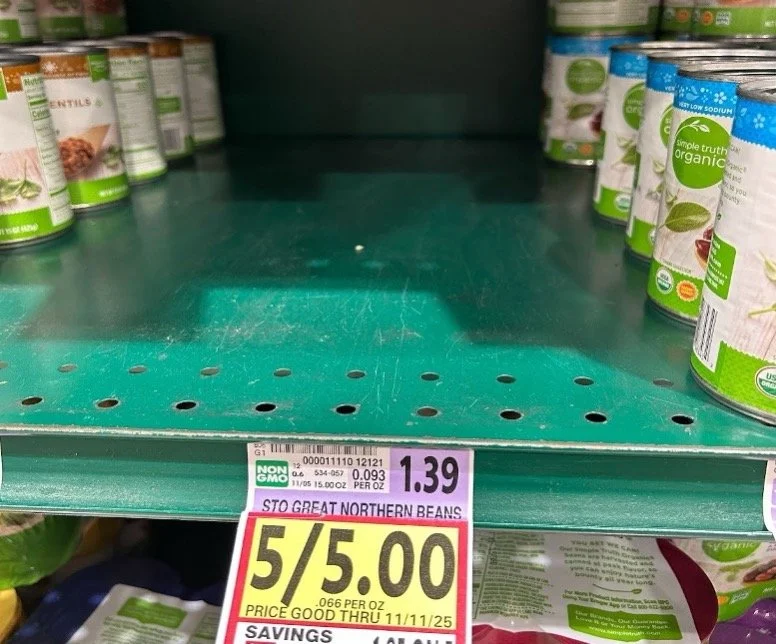
A recent look down a grocery aisle made the point clearly:
A store-brand can of beans, on sale for $1 a can, were all gone.
A familiar regional brand at $1.25 per can was about half gone.
The national brand at $1.69 sat fully stocked.
Three cans of beans. Three prices. A 69-cent difference – a swing of nearly 70 percent from the cheapest option to the most expensive.
That is affordability in practice. Price sorts choices quickly. Americans vote with their carts.
Most families make these decisions quietly. They switch brands, change proteins, buy less of something they like, or stretch meals another day. They do it because other bills tighten first. Food is rarely the largest household expense. Housing, health care, transportation, utilities, insurance – and for many families, phone, streaming, and internet bills – come ahead of it. Those costs are largely fixed. Food is where families feel the pinch and adjust.
Affordability is not about whether a meal can be assembled cheaply in theory. It is about whether households can keep making reasonable choices week after week without falling behind somewhere else. That distinction matters, because it is often lost when food debates drift toward ideals rather than household realities.
This is also why food should not be treated as a political price index. Eggs, milk, and ground beef are not the same as gas prices. Food prices move for many reasons at once: weather across multiple regions, disease outbreaks that affect crops and herds, labor shortages, fuel and transportation costs, global trade disruptions, and rules that compound over time. No single lever sets the price of food – and no government can command farmers and food producers to drill for more today and turn on a spigot tomorrow.
In a system this large and interdependent, short-term fixes rarely deliver lasting relief. History shows that interventions designed to signal control often raise costs rather than lower them, especially when they disrupt production or reduce flexibility. Stability depends less on slogans than on whether the system can keep operating at scale.
That flexibility makes food both essential and vulnerable in household budgets.
Keeping food affordable over time depends less on retail gestures than on whether the underlying system continues to function.
The pull of nostalgia – and its limits
This is where a familiar counterargument often enters the conversation. Americans once spent more of their income on food, the story goes, and what they ate was better. Over time, the food system’s productivity delivered cheaper calories, poorer diets, and worse health outcomes. The money “saved” at the grocery store simply reappeared as healthcare spending. The answer, therefore, is to spend more on food again.
The appeal of this argument is understandable. But it asks one explanation to carry more weight than it can bear – and it is often used to justify policies that knowingly raise food costs without addressing the pressures households actually face.
Decades ago, Americans spent a larger share of their income on food because overall incomes were lower.[1] Food simply consumed more of the household budget. Food safety was worse. Life expectancy was shorter. After World War II, the country urbanized, families and the workforce changed, and productivity rose across the economy. Diets were not uniformly virtuous. Processed foods, refined grains, and shelf-stable staples were already common.
Healthcare spending rose for different reasons. People live longer. Medicine does more. Conditions that once killed people now receive ongoing treatment. That is a fiscal challenge, but it is not a simple exchange between grocery bills and doctor visits.
There is another reason this nostalgia resonates. For many Americans, “good food” has never been more visible. Upscale grocers, select fast-casual restaurant chains, and specialty brands project an image of abundance and care built around freshness, simplicity, and choice. That world is real, and for those who can afford it, it is appealing.
But visibility is not the same as capacity.
Those groceries and restaurants are more expensive to operate, slower to grow, and narrower in reach. By design, they serve a slice of the market. They matter culturally and commercially. But they do not set the affordability baseline for most households – and they do not feed the country.
A nation of more than 330 million people is fed day after day by systems built for scale – systems designed to deliver safe, protein-rich, nutrient-dense food reliably and affordably. Farms, processors, distributors, and retailers move large volumes efficiently, safely, and predictably. Much of that food does not market itself as niche or aspirational. It markets itself on what Americans consistently say they value most: safety, affordability, reliability, taste and choice. It shows up quietly in grocery carts, school cafeterias, hospitals, and kitchens across the country.
Niche food systems are not a failure. They are a feature of prosperity. But they coexist with – rather than replace – the systems that sustain most Americans. Confusing the two invites policies that celebrate visibility while undermining capacity, raising costs for the families most sensitive to price.
Food at scale – and why it matters
What often gets lost in these debates is what has actually worked, and what affordability depends on.
Modern agriculture at scale has delivered abundant, safe, protein-rich, nutrient-dense food at prices that remain historically low as a share of income, even after recent inflation. Chicken, pork, eggs, dairy, and staple grains remain among the most cost-efficient sources of nourishment available anywhere.
That does not mean food is cheap for everyone. It means it would be far more expensive without scale, productivity, and continuous improvement across farms and the supply chain. When production is constrained or fragmented, costs rise and choices narrow. Those costs do not disappear. They show up on the shelf.
Affordability has two sides – and neither works without the other.
On the household side, people need the freedom and prosperity to buy food without constant calculation. Wages matter. Growth matters. Without progress on incomes, food remains the margin where families are forced to compromise.
On the production side, food must be grown, processed, and distributed at scale for a population this large. That requires room to operate, invest, and improve. It also requires profit. When the ability to operate erodes, affordability erodes with it.
When the Carver Center says it focuses on affordability, access, and sound nutrition for all Americans, this is what we mean by affordability. Not cheap food at any cost. Not nostalgia. A system where farmers can keep producing, businesses can keep operating, and families can keep choosing – without turning the grocery aisle, lunch tray or dinner plate into a political battlefield.
Price will always matter. Tradeoffs will always exist.
The question is whether the system keeps them manageable.
That is the test that matters.
Footnote
[1] Over the long term, food has become a smaller share of household resources: Americans spent roughly 17 percent of disposable personal income on food in 1960, compared with about 10 percent today, even after recent inflation, according to USDA Economic Research Service data.