
When Belief Replaces Evidence, Consumers and Farmers Pay the Price
When Belief Replaces Evidence, Consumers and Farmers Pay the Price
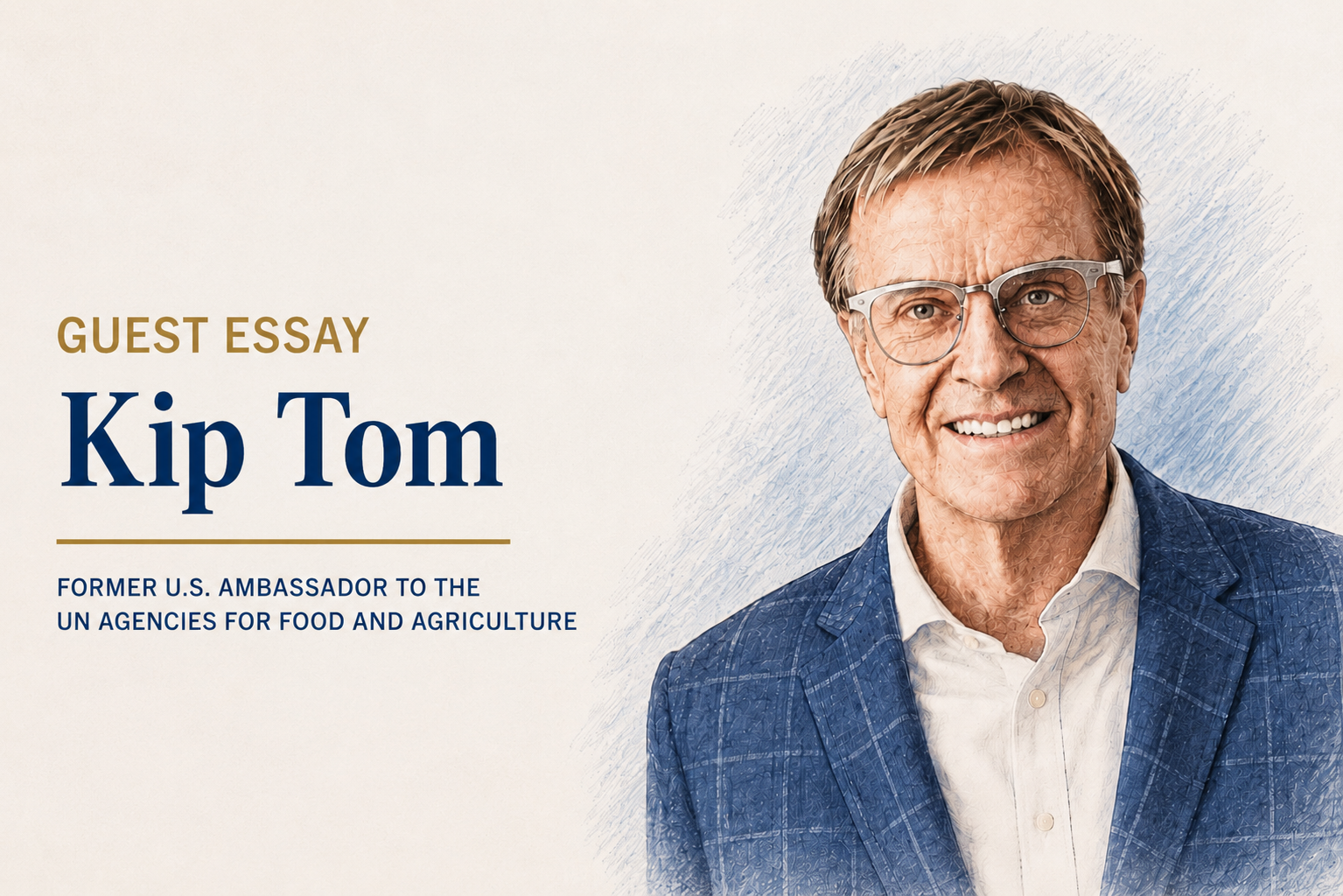
By Kip Tom
Former U.S. Ambassador to the UN Agencies for Food and Agriculture
Four years ago, Sri Lanka's government decided that its farmers were poisoning the country. The established science was contested. The economics were ignored. But the belief was firm, and the belief became law. Chemical fertilizers and pesticides were banned overnight. Within six months, rice yields had collapsed by more than 30 percent. Food prices entered hyperinflation. Farmers who had never protested marched by the tens of thousands. The president fled the country as the government teetered. A peer-reviewed analysis published in March confirmed what the wreckage already showed: this was not a science-based agricultural transition. It was an unproven belief, codified into law, imposed on a food system that could not survive it.
That sequence – belief becomes law, law breaks the system – is not a Sri Lankan problem. It is a governance problem. And it is the problem now sitting at the center of many current American agricultural debates.
For several years, a growing class of podcasters, social media influencers, and wellness entrepreneurs has been telling American consumers that their food is poison. That the farming system, one that feeds 330 million Americans and billions more around the world, is making them sick. These claims are not supported by the weight of independent science. They are not validated by the regulatory bodies of the United States, the European Union, Japan, or Australia. They are, in many cases, directly contradicted by the peer-reviewed literature. But the believers have built enormous audiences, generated enormous revenue, and now – critically – they have found their way into the ears of policymakers.
This should alarm anyone who cares about sound governance. The problem is not that people hold unconventional beliefs about food and farming. People are free to believe what they choose. The problem is when those beliefs, untested and unproven, get written into law. At that point, the American system of governance – which is supposed to be grounded in evidence, in process, in the rigorous establishment of what is actually true – gets replaced by something closer to ideology. And ideology, as Sri Lanka demonstrated in the most brutal possible terms, does not feed people.
Science is not perfect. It is, however, the most reliable method humanity has developed for establishing what is objectively true about the physical world. When policymakers abandon that standard – when they legislate based on what influential voices assert rather than what the evidence demonstrates – they are not making a stylistic choice about governance. They are removing the load-bearing wall. The structure may stand for a while. Eventually it falls.
American agriculture has earned the right to be defended by evidence. Today, farmers use significantly less fertilizer, fewer pesticides and herbicides, less fuel, and less labor than at any point in modern history, while producing more food per acre than any previous generation. That is not an accident. It is the result of decades of innovation grounded in land-grant research, USDA science, and private sector investment. The food that leaves American farms is safe. That is a verifiable fact, not a marketing claim.
The Farm Bill is the topic of the day. It is also the legal architecture that governs whether American agriculture is shaped by what the evidence shows or by what the most persuasive voices on the internet assert. Right now, both ends of the ideological spectrum are competing to embed their preferred beliefs into that architecture, with some advocates driving now to legislate against farming inputs that the science supports, just as climate mandate proponents spent the last Farm Bill cycle redirecting billions away from farmers and toward programs that did more for Washington grant recipients than for rural economies. Neither group is starting from the evidence. Both are starting from the conclusion.
The consequences of that approach are predictable because they have already been observed. In Europe, the Farm to Fork program, built on the same ideological foundation that destroyed Sri Lanka's harvest, was eventually abandoned after farmers across the continent protested its unworkable mandates. In Sri Lanka, the cost was a government. In both cases, the farmers knew before the policymakers did. They always do, because they are the ones who have to make the system actually work.
Congress has the opportunity to pass a Farm Bill grounded in science and sound economics – one that protects farmers' access to proven inputs, rewards genuine environmental stewardship, and refuses to codify unproven claims into law regardless of how loudly or how confidently those claims are made. That is not a partisan position. It is the minimum standard for responsible governance of a food system that the world depends on.
Sri Lanka's farmers marched until their government fell. The lesson is not about Sri Lanka. It is about what happens to any system, anywhere, when the people who make the laws stop asking what is true and start asking only what they believe.
Kip Tom is a seventh-generation Indiana farmer and former U.S. Ambassador to the United Nations Agencies for Food and Agriculture. He co-chaired Farmers and Ranchers for Trump in the 2024 presidential election.
We welcome guest essays from policymakers, researchers, and advocates working on food and agricultural policy. Contact us at info@carverfood.org.