
Who Gets to Participate?
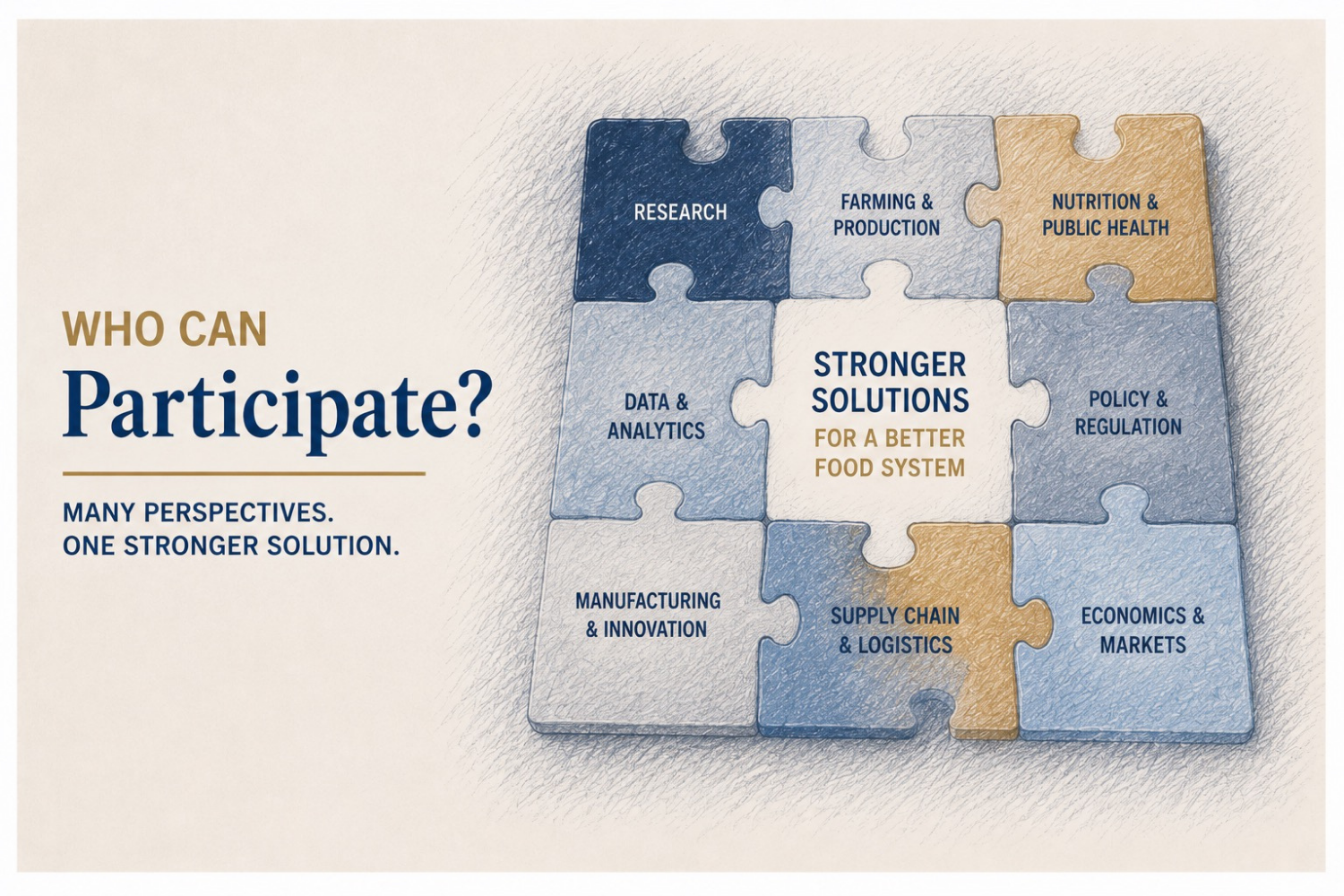
Who Gets to Participate?
By Andy Curliss
Over the past year, I served on the search committee for the next dean of the School of Law at the University of North Carolina at Chapel Hill. I am not a lawyer, nor a graduate of the law school. The committee included accomplished attorneys, scholars, public servants, and university leaders. My own contribution came from a different direction: journalism, communications, data and analytics, policy, and institutional strategy.
Each person brought something the others couldn’t.
Serious organizations operate that way. Complex problems require different forms of expertise, experience, and practical understanding.
Food and nutrition policy is no exception.
Food policy operates at the intersection of biology, economics, regulation, logistics, public health, consumer behavior, and affordability. Decisions made in regulatory agencies, legislatures, courtrooms, and advocacy campaigns eventually show up in grocery stores, school meal programs, household budgets, and on dinner tables.
Understanding those systems requires engagement with how they actually function.
A researcher studying dietary protein may work with agricultural scientists, public health officials, or food manufacturers. Hunger organizations work directly with the realities of food distribution, affordability, supply chains and the barriers families face in accessing food.
Professional affiliations provide context. But affiliation should be a starting point for scrutiny, not a conclusion. The more important question is whether the evidence and conclusions actually hold up.
For food and agriculture policy, that matters enormously.
Policies involving dietary guidance, school nutrition, sustainability, ingredient standards, food assistance, and agricultural production affect millions of families directly. They shape affordability, access, and nutritional adequacy across the country.
Those questions cannot be answered responsibly through theory alone, and they can't be answered well by excluding the people who understand how the systems work.
The Carver Center for Agriculture & Nutrition was established on that principle. We bring together perspectives from journalism, nutrition science, hunger relief, agriculture, policy, and applied research so that claims shaping food and nutrition debates are tested against evidence, methods, context, and real-world consequences. Some publications are institutionally authored. Others include named contributors. The standard is consistent.
Our work includes rigorous analysis and research, as well as perspectives and essays, focused on how to provide food affordably, at scale, for everyone who needs it.
Different backgrounds help people see different parts of the same system. The standard should be the same for everyone: show the evidence, test the assumptions, examine the methods, and let the work stand on its own.
Andy Curliss is Chairman of the Carver Center for Agriculture & Nutrition. He also serves as Vice President of Strategic Engagement at the National Pork Producers Council. He previously worked in technology and advanced analytics and spent two decades as a reporter and editor at The News & Observer of Raleigh, NC.